This is the English edition of a video from my Japanese YouTube channel, iestaLife. I review gadgets and household fixes from my home in Japan, so product links go to Amazon Japan.
Quick take
Two thin plastic parts on my kid’s toys kept snapping, and super glue never held because the joint was so small. Plarepair, a Japanese two-part repair kit (resin powder plus a solvent liquid), rebuilt the broken spots much stronger than glue did. My first attempt went wrong, though: the liquid flowed everywhere and locked a propeller in place. Once I found a better technique, the second repair turned out solid.

What I tested
- Plarepair, clear version (powder, liquid, dropper and a needle tip)
- A toy duck whose propeller had snapped at its thin base
- A toy wheel-and-axle part that broke where its weight sits
- The two methods printed inside the package: the “needle” method and the “sprinkle” method

What I found
The liquid runs more than you expect. Squeezing the bottle with the needle tip, it kept flowing and dripped onto the desk. It also has a strong smell, very much like a dentist’s office, so work somewhere ventilated.
The first repair failed. Even a “small” amount set into a large blob, and it filled the propeller’s spinning shaft. The joint itself was rock hard, but the propeller no longer turns. A drop that landed on the blue helmet also melted the surface.

The second repair worked. On the axle, I built resin all the way around the break. The liquid wicks into the cracks, and after curing it was much stronger than with super glue, though not quite as strong as the original part. The sharp 90-degree corner became a gentle curve, and in clear resin the build-up is less visible than I expected.

Timing is the trick. What worked best for me was dripping the liquid onto the powder and carrying it to the part right away, while it is still slightly runny. Waiting longer made it harder to place.
| Technique | Result |
|---|---|
| Dripping straight from the bottle | Kept flowing; set on the shaft and the toy body |
| Liquid on powder, then waiting | Already setting; hard to place |
| Liquid on powder, carried right away | Clumped nicely and was easy to place |
| Turning moving parts before full cure | The wheel axle still turns |
Who it’s for
- Good for thin or load-bearing plastic parts that super glue can’t hold
- Good for filling cracks or building up a broken shape
- Not ideal if a moving part has to keep moving—beginners will likely lock it, as I did
- Not ideal if you dislike strong smells or messy, runny liquids
Watch the video
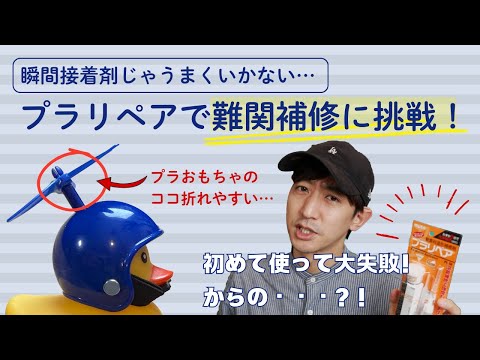
The video is in Japanese, but the hands-on parts are easy to follow. Useful moments: around 3:00 when the repair starts, 18:20 when I find the technique that works, and 21:30 for the cautions.
Limitations
These are two small toy repairs with one color of Plarepair. Cured resin is very hard, but its grip on the original plastic is weaker: it held well against pressing forces and came off more easily when pulled in a peeling direction. Protect any surface you don’t want marked, because the liquid softens plastic it touches.
Products
Plarepair Clear (PL16C): on Amazon Japan
The Amazon Japan link above is an affiliate link. As an Amazon Associate, I earn from qualifying purchases. Check the listing for the exact model, current price and shipping availability in your region.
More reviews in English


All Home & Everyday (29) →Browse all English reviews →
This review is also available in Japanese.